Category Archives: Learn English

Learn English

Past Continuous Tense

                                                     Past Continuous Tense

In this tutorial, we will learn about  Past Continuous Tenses

Prerequisites

Before starting with this tutorial we assume that you are best aware of the following  topics:

  • Nouns.
  • Pronouns.
  • Verbs.
  • Adjectives.
  • Adverbs.
  • Prepositions.
  • Conjunctions.
  • Interjections.

What Past Continuous Tense?

The past continuous tense, also known as the past progressive tense is an action that continued in past for a Time,refers to a continuing action or state that was happening at some point in the past.

Past Continuous Tenses  refers to:

  1. An action that continued in past for a while: He was making notes of maths.
  2. An action that happened in past regularly: He was working in a private school before this year.

Formula:-

  1. POSITIVE/AFFIRMATIVE SENTENCES:
S              +             WAS/WERE        +             V+ing    +             O.               

I                              was                       watching              cricket.
We                         were                     watching              cricket.
You                        were                     watching              cricket.
They                      were                     watching              cricket.
Boys                      were                     watching              cricket.
He                          was                       watching              cricket.
She                        was                       watching              cricket.
It                             was                      watching              cricket.
Ravi                        was                      watching              cricket.

S              +             WASN’T/WEREN’T          +             V+ing    +             O.               
  1. NEGATIVE SENTENCES:

I                              wasn’t                   watching              cricket.
We                         weren’t                 watching              cricket.
You                        weren’t                 watching              cricket.
They                      weren’t                 watching              cricket.
Boys                      weren’t                 watching              cricket.
He                          wasn’t                   watching              cricket.
She                        wasn’t                   watching              cricket.
It                             wasn’t                  watching              cricket.
Ravi                        wasn’t                  watching              cricket.

  1. INTERROGATIVE SENTENCES:
WAS/WERE        +             S              +             V+ing    +             O.?               

Was                       I                               watching              cricket?
Were                     we                           watching              cricket?
Were                     you                         watching              cricket?
Were                     they                        watching              cricket?
Were                     boys                       watching              cricket?
Was                       he                           watching              cricket?
Was                       she                         watching              cricket?
Was                       It                             watching              cricket?
Was                       Ravi                        watching              cricket?

  1. INTERROGATIVE NEGATIVE SENTENCES:
WASN’T/WEREN’T          +             S              +             V+ing    +             O.?               

Wasn’t                                  I                             watching              cricket?
Weren’t                               we                          watching              cricket?
Weren’t                               you                        watching              cricket?
Weren’t                               they                       watching              cricket?
Weren’t                               boys                      watching              cricket?
Wasn’t                                  he                         watching              cricket?
Wasn’t                                  she                       watching              cricket?
Wasn’t                                  It                           watching              cricket?
Wasn’t                                  Ravi                      watching              cricket?

Rules:

  1. I, he, she, it and third person singular: was
  2. we, you, they and plural subjects – were

Here We can put any W-H words before interrogative and interrogative formulae.
Future Simple Tense

                                                                          Future Simple Tense

In this tutorial, we will learn about  Future Simple Tenses

Prerequisites

Before starting with this tutorial we assume that you are best aware of the following  topics:

  • Nouns.
  • Pronouns.
  • Verbs.
  • Adjectives.
  • Adverbs.
  • Prepositions.
  • Conjunctions.
  • Interjections.

What Future Simple Tense?

Future Simple  Tense is  an action that we have not started at the time of we are  speaking ,Tense that’s used to talk about things that haven’t happened yet. It will be start e.g He will buy a new car.He will be engaged soon.

Future simple tense refers to:

  1. An action that we have not started doing at the time of speaking: He will buy a new car.
  2. An action that we plan to do in coming time: I will get married in next month.
  3. A prediction in terms of action/event/state: I think he will take maths subject.
  4. An expected action: If you water a plant regularly, it will grow faster.

Formula:-

  1. POSITIVE SENTENCES:
S              +             WILL/SHALL       +             V1           +             O.

I                            shall                           write                a novel.
We                       shall                           write                a novel.
You                      will                             write                 a novel.
They                    will                             write                 a novel.
Boys                    will                             write                 a novel.
He                        will                            write                  a novel.
She                      will                            write                   a novel.
It                           will                           write                   a novel.
Ravi                      will                           write                   a novel.


  1. POSITIVE SENTENCES:
S              +             WON’T/SHAN’T                               +             V1           +                O.

I                                        shan’t                                   write                     a novel.
We                                    shan’t                                   write                     a novel.
You                                   won’t                                    write                     a novel.
They                                 won’t                                    write                     a novel.
Boys                                 won’t                                    write                     a novel.
He                                     won’t                                    write                     a novel.
She                                   won’t                                    write                     a novel.
It                                        won’t                                    write                     a novel.
Ravi                                   won’t                                    write                     a novel.

  1. INTERROGATIVE SENTENCES:
WILL/SHALL       +             S              +             V1           +             O.?

Shall                                       I                               write                     a novel?
Shall                                       we                           write                     a novel?
Will                                         you                         write                     a novel?
Will                                         they                        write                     a novel?
Will                                         he                           write                     a novel?
Will                                         she                         write                     a novel?
Will                                         it                             write                     a novel?
Will                                         Ravi                        write                     a novel?

  1. INTERROGATIVE NEGATIVE SENTENCES:
WON’T/SHAN’T                               +             S              +             V1           +                O.?

Shan’t                                   I                               write                     a novel?
Shan’t                                  we                           write                     a novel?
Won’t                                   you                         write                     a novel?
Won’t                                   they                        write                     a novel?
Won’t                                    he                          write                     a novel?
Won’t                                    she                        write                     a novel?
Won’t                                    it                            write                     a novel?
Won’t                                   Ravi                        write                     a novel?

Rules:

  1. I, we –              shall
  2. Other subjects – will

NOTE: According to modern English rule, we can use WILL with I and WE also. It means if we do not use SHALL, it would not be considered as a grammatical mistakes.

Future Perfect continuous Tense

                                                  Future Perfect continuous Tense

In this tutorial, we will learn about  Future Perfect Continuous Tenses

Prerequisites

Before starting with this tutorial we assume that you are best aware of the following  topics:

  • Nouns.
  • Pronouns.
  • Verbs.
  • Adjectives.
  • Adverbs.
  • Prepositions.
  • Conjunctions.
  • Interjections.

What is Present Perfect Tense?

The present perfect tense is  an action that occurred at an undefined time in the past (e.g., we have played before) or started in the past and continued to the present time .This formed by have/has Helping verb.

Future Perfect continuous Tense refers to:

  1. An action which has not started yet but will be starting: This tree will have been giving us fruits for next few years.
  2. An action that will be going on from/by a particular time period: I will have been working in this company by next two years more.

Formula:-

  1. POSITIVE SENTENCES
S   +   WILL/SHALL   +   HAVE   +   BEEN   +Ving   +   O.   +   SINCE/FOR/BY+TIME.

I               shall       have         been       doing    homework     by two hours.
We          shall       have          been      doing     homework     by two hours.
You         will         have          been      doing     homework     by two hours.
They       will         have          been      doing     homework     by two hours.
Boys       will         have          been      doing     homework     by two hours.
He           will        have           been      doing     homework     by two hours.
She         will        have           been      doing     homework     by two hours.
It             will        have           been      doing     homework     by two hours.
Ravi        will        have           been      doing     homework     by two hours.

  1. NEGATIVE SENTENCES
S   +   WON’T/SHAN’T   +   HAVE   +   BEEN   +Ving   +   O.   +   SINCE/FOR/BY+TIME.

I                 shan’t                       have          been     doing    homework     by two hours.
We            shan’t                       have          been     doing    homework     by two hours.
You           won’t                        have          been     doing    homework     by two hours.
They         won’t                        have          been     doing    homework     by two hours.
Boys         won’t                        have          been     doing    homework     by two hours.
He             won’t                        have          been     doing    homework     by two hours.
She           won’t                        have          been     doing    homework     by two hours.
It               won’t                        have          been     doing    homework     by two hours.
Ravi          won’t                        have          been     doing    homework     by two hours.


  1. INTERROGATIVE SENTENCES
WILL/SHALL   +   S   +   HAVE   +   BEEN   +Ving   +   O.   +   SINCE/FOR/BY+TIME?

Shall                 I                  have          been     doing    homework     by two hours?
Shall                 we               have          been     doing    homework     by two hours?
Will                   you             have          been     doing    homework     by two hours?
Will                   they            have          been     doing    homework     by two hours?
Will                   boys           have          been     doing    homework     by two hours?
Will                   he                have          been     doing    homework     by two hours?
Will                   she              have          been     doing    homework     by two hours?
Will                   it                  have          been     doing    homework     by two hours?
Will                  Ravi              have          been     doing    homework     by two hours?

  1. INTERROGATIVE NEGATIVE SENTENCES
WON’T/SHAN’T   +   S   +   HAVE   +   BEEN   +Ving   +   O.   +   SINCE/FOR/BY+TIME?

Shan’t                         I                have         been     doing    homework     by two hours?
Shan’t                       we              have         been     doing    homework     by two hours?
Won’t                       you             have         been     doing    homework     by two hours?
Won’t                       they            have         been     doing    homework     by two hours?
Won’t                       boys           have         been     doing    homework     by two hours?
Won’t                       he               have         been     doing    homework     by two hours?
Won’t                       she             have         been     doing    homework     by two hours?
Won’t                       it                 have         been     doing    homework     by two hours?
Won’t                       Ravi            have         been     doing    homework     by two hours?


Rules:

  1. I, we –       shall
  2. Other subjects – will

NOTE: According to modern English rule, we can use WILL with I and WE also. It means if we do not use SHALL, it would not be considered as a grammatical mistakes.

NOTE:   In this tense, we also use ending time of the action we do. To show ending time, we use “BY (which means almost)” and it doesn’t matter whether the time is point of time or period of time.

Sentence Factors

In this tutorial, we will learn about Sentence Factors

Prerequisites

Before starting with this tutorial we assume that you are best aware of the following  topics:

  • Nouns.
  • Pronouns.
  • Verbs.
  • Adjectives.
  • Adverbs.
  • Prepositions.
  • Conjunctions.
  • Interjections.

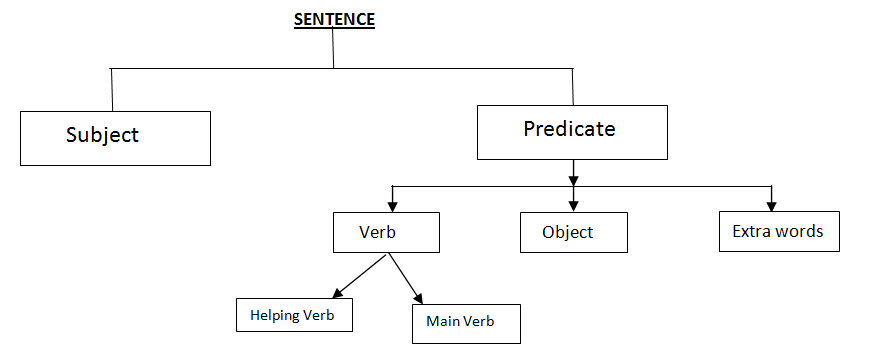
Here we are going to learn about sentence factors (Parts of a Sentence).
A sentence has been usually made up of different types of words and we place these words at their certain places according to their role in that sentence. We call these places as parts of a sentence.


Let us understand these parts one by one:

  1. A subject: A subject is a part of the sentence which tells us who we talk about. In a sentence doer of the action or the noun/pronoun which we talk about is called a sentence.

Examples:

  1. Hari is waiting for the bus. (ask….who is waiting….?)
  2. My father is an army man. (ask…who is an army man…?)
  3. India’s president will deliver a speech. (ask…who will deliver…?)
  4. This car runs very fast.

In above four examples, we can see clearly that “Hari, my father, India’s president, and this car” tell us about the doer of action or the person or a thing we talk about. They all called a subject in their respective sentences.

  1. A predicate: A predicate, in a sentence, is a part of the sentence without subject.

In the above examples, if we remove subjects, the remaining part of the sentences is called a predicate.
Example: Hari is waiting for the bus.
Here the underlined part, without subject, is the predicate for this sentence.
A predicate has the following sub-parts:

  1. A verb: A verb, in a sentence, is a part of the sentence which tells us about the action and the time of the action (Present,Past or Future)

There are two types of verbs:
Helping Verb: This tells you the tine of action in a sentence.
Example: He was writing a letter to his father. (here ‘Was’ shows past tense)
Main verb: This tells you about the action takes place in the sentence.
Example: I am typing an e-mail. (her the word ‘typing’ shows action)

  1. An object: in a sentence, an object is a noun or pronoun that receives the action done by the subject or that comes after subject. In a sentence, there may be more than one object.
  2. Examples: Hari is waiting for the bus. (ask….who is waiting….?)
  3. My father is an army man. (ask…who is an army man…?)
  4. India’s president will deliver a speech. (ask…who will deliver…?)
  5. This car runs very fast.

In the above examples, the underlined words are objects for their respective sentences.

  • Extra words: In a sentence, after selecting the subject, verb(helping and main verb) and objects, all the other words are extra words for that sentence.

Example:

My grandfather was living in Indore before last year.
(My grandfather- subject
Was– helping verb
Living– action
In Indore– object
Before last year- extra words.)

In the next lesson, we will learn how to place these parts of sentences to make a meaningful sentence. We will also learn the structures of different types of sentences and how to interchange one type of sentences into another one.

Present Perfect Tense

                                                   PRESENT PERFECT TENSE

In this tutorial, we will learn about  Present Perfect Tenses:

Prerequisites

Before starting with this tutorial we assume that you are best aware of the following  topics:

  • Nouns.
  • Pronouns.
  • Verbs.
  • Adjectives.
  • Adverbs.
  • Prepositions.
  • Conjunctions.
  • Interjections.

Present Perfect Tense refers to:

  1. A completed action in recent past and relevant to present: I have known you since I was ten.
  2. An indefinite action in past: Have you been to this place before?
  3. An action that just ended before the time of speaking: I have just taken my lunch.
  4. A repeated action that continues till the present time: He has made many centuries before this.
  5. A mental action in progress: He has always enjoyed his responsibility as a captain.

What is Present Perfect Tense ?

The Present Perfect Tense is a tense used in present to indicate the action that has taken place at specific time.

Formula:

  1. POSITIVE/AFFIRMATIVE SENTENCES:
S              +             HAS/HAVE          +             V3           +             O.

I                          have                         done                 homework         just now.
We                     have                         done                 homework         just now.
You                    have                         done                 homework         just now.
They                  have                         done                 homework         just now.
Children            have                        done                  homework         just now.
He                      has                           done                 homework         just now.
She                    has                           done                 homework         just now.
It                        has                            done                homework         just now.
Rahul                has                            done                 homework         just now.

  1. NEGATIVE SENTENCES:
S              +             HASN’T/HAVEN’T            +             V3           +             O.

I                    haven’t                                             done               homework         just now.
We               haven’t                                             done               homework         just now.
You              haven’t                                             done               homework         just now.
They            haven’t                                             done               homework         just now.
Children     haven’t                                             done               homework         just now.
He               hasn’t                                               done                homework         just now.
She             hasn’t                                               done                homework         just now.
It                 hasn’t                                               done                homework         just now.
Rahu          hasn’t                                               done                homework         just now.


3.INTERROGATIVE SENTENCE:

HAS/HAVE          +             S              +             V3           +             O.?

Have                                      I                              done                     homework         just now?
Have                                      we                          done                     homework         just now?
Have                                      you                        done                      homework         just now?
Have                                      they                       done                      homework         just now?
Have                                      children                done                      homework         just now?
Has                                         he                          done                     homework         just now?
Has                                         she                        done                     homework         just now?
Has                                         it                            done                     homework         just now?
Has                                         Ravi                       done                     homework         just now?

  1. INTERROGATIVE NEGATIVE SENTENCES:
HASN’T/HAVEN’T            +             S              +             V3           +             O.?

Haven’t                              I                             done                     homework         just now?
Haven’t                               we                        done                     homework         just now?
Haven’t                              you                       done                      homework         just now?
Haven’t                              they                      done                      homework         just now?
Haven’t                              children               done                      homework         just now?
Hasn’t                                he                         done                      homework         just now?
Hasn’t                                she                       done                      homework         just now?
Hasn’t                                it                           done                      homework         just now?
Hasn’t                                Ravi                      done                      homework         just now?
Rules:

  1. I, we, you, they, plural subjects: Have
  2. He, she, it, singular subject: Has

We can put any W-H words before interrogative and interrogative formulae.

Present Perfect Continuous Tense

                                       PRESENT PERFECT CONTINUOUS TENSE

In this tutorial, we will learn about Present Perfect Continuous Tense.

Prerequisites

Before starting with this tutorial we assume that you are best aware of the following  topics:

  • Nouns.
  • Pronouns.
  • Verbs.
  • Adjectives.
  • Adverbs.
  • Prepositions.
  • Conjunctions.
  • Interjections.

Present Perfect Continuous Tense refers to:

  1. An action that has started in past and still going on: We have been writing this book since year 2020.
  2. In this tense, we mention duration of time of the action: I have been working in this institution for three years.
  3. An action that has ended just before the time of speaking: My country has been keeping a close watch over the vaccination data.

What is Present Perfect Continuous Tense.

Present Perfect Continuous Tense, also some time called the present progressive or present imperfect, is a verb used in modern English that include the present tense as  well as the continuous aspect.

Formula:-

  1. POSITIVE/AFFIRMATIVE SENTENCES:
S   + HAS/HAVE   +   BEEN   +   V+ing   +    O.   +   SINCE/FOR   +   TIME.

I               have                 been        playing     chess          since               2 o’clock.
We          have                 been        playing     chess          since               2 o’clock.
You         have                been         playing     chess          since               2 o’clock.
They       have                been         playing     chess          since               2 o’clock.
Kids        have                been         playing     chess          since               2 o’clock.
He           has                  been         playing     chess          since               2 o’clock.
She         has                  been         playing     chess          since               2 o’clock.
It             has                  been         playing     chess          since               2 o’clock.
Ravi        has                  been         playing     chess          since               2 o’clock.

  1. NEGATIVE SENTENCES:
S   + HASN’T/HAVEN’T   +   BEEN   +   V+ing   +    O.   +   SINCE/FOR   +   TIME.

I                haven’t           been        playing     chess          since               2 o’clock.

We           haven’t           been        playing     chess          since               2 o’clock.
You          haven’t           been        playing     chess          since               2 o’clock.
They        haven’t           been        playing     chess          since               2 o’clock.
Kids         haven’t           been        playing     chess          since               2 o’clock.
He           hasn’t              been        playing     chess          since               2 o’clock.
She          hasn’t             been        playing     chess          since               2 o’clock.
It              hasn’t             been        playing     chess          since               2 o’clock.
Ravi         hasn’t             been        playing     chess          since               2 o’clock.


  1. INTERROGATIVE SENTENCES:
HAS/HAVE   +     S      +   BEEN   +   V+ing   +    O.   +   SINCE/FOR   +   TIME?

Have                             I              been        playing     chess               since               2 o’clock?
Have                             we          been        playing     chess               since               2 o’clock?
Have                             you        been        playing     chess               since               2 o’clock?
Have                             they       been        playing     chess               since               2 o’clock?
Have                             kids        been        playing     chess               since               2 o’clock?
Has                               he           been        playing     chess               since               2 o’clock?
Has                               she         been        playing     chess               since               2 o’clock?
Has                               It             been        playing     chess               since               2 o’clock?
Has                               Ravi        been        playing     chess               since               2 o’clock?

  1. INTERROGATIVE NEGATIVE SENTENCES:
HASN’T/HAVEN’T   +     S      +   BEEN   +   V+ing   +    O.   +   SINCE/FOR   +   TIME?

Haven’t                       I                  been        playing   chess                                 since      2 o’clock?
Haven’t                       we              been        playing   chess                                 since     2 o’clock?
Haven’t                       you             been        playing   chess                                 since     2 o’clock?
Haven’t                       they            been        playing   chess                                 since     2 o’clock?
Haven’t                       kids             been        playing   chess                                since     2 o’clock?
Hasn’t                         he                been        playing   chess                                 since     2 o’clock?
Hasn’t                         she              been        playing   chess                                since     2 o’clock?
Hasn’t                         it                  been        playing   chess                                 since     2 o’clock?
Hasn’t                         Ravi             been        playing   chess                                 since     2 o’clock?
NOTE:-

USE OF SINCE AND FOR:

We use ‘Since and for’ to show the starting time of the action going on.

We use ‘Since’ to show point of time. If we speak any time with ‘Since’ it shows a perfect starting time of that particular action.

Like: since 1 o’clock, since Monday, since 1st January, since year 2020, since morning etc.

We use ‘for’ to show a time duration/ period of time of that particular action

Like: for one hour, for two days, for one month, for one year, for one century etc.

I have been reading this story since 10am.

I have been reading this book for two hours.

So, we have learned all types of tenses in present time.

Present Continuous Tense.

                                                Present continuous tense

In this tutorial, we will learn about  Present Continuous Tense:

Prerequisites

Before starting with this tutorial we assume that you are best aware of the following  topics:

  • Nouns.
  • Pronouns.
  • Verbs.
  • Adjectives.
  • Adverbs.
  • Prepositions.
  • Conjunctions.
  • Interjections.

Present Continuous tense refers to:

  1. An action in progress at the time of speaking: – I am typing my grammar notes.
  2. A definite plan in future: – we are buying a new car this month.
  3. To make a prediction: – this work is going to be very difficult for you.
  4. Expected long term duration work happening continuously: – I am working with a new company these days.

What is Present Continuous Tense ?

The present continuous verb tense Shows that an Action or Condition is happening right Now, or frequently, and may continue into the Future.

Formula:-

  1. POSITIVE/AFFIRMATIVE SENTENCES:
S              +             IS/AM/ARE         +             V+ing    +             O.               

I                              am                         watching              cricket.
We                         are                         watching              cricket.
You                        are                         watching              cricket.
They                      are                         watching              cricket.
Boys                      are                         watching              cricket.
He                          is                            watching              cricket.
She                        is                            watching              cricket.
It                            is                            watching              cricket.
Ravi                       is                            watching              cricket.

2.NEGATIVE SENTENCES:

S              +             ISN’T/AM NOT/AREN’T +             V+ing    +             O.               

I                              am not                 watching              cricket.
We                         aren’t                    watching              cricket.
You                        aren’t                    watching              cricket.
They                      aren’t                    watching              cricket.
Boys                      aren’t                    watching              cricket.
He                          isn’t                       watching              cricket.
She                        isn’t                       watching              cricket.
It                            isn’t                       watching              cricket.
Ravi                       isn’t                       watching              cricket.

  1. INTEROGATIVE SENTENCES:
IS/AM/ARE         +             S              +             V+ing    +             O.?               

Am                        I                              watching              cricket?
Are                        we                          watching              cricket?
Are                        you                         watching             cricket?
Are                        they                        watching             cricket?
Are                        boys                       watching             cricket?
Is                           he                           watching             cricket?
Is                           she                         watching             cricket?
Is                           It                             watching             cricket?
Is                           Ravi                        watching             cricket?

  1. INTERROGATIVE NEGATIVE SENTENCES:
ISN’T/AM NOT/AREN’T +             S              +             V+ing    +             O.?               

Am                                         I               not                       watching              cricket? (Special case)
Aren’t                                   we                                         watching              cricket?
Aren’t                                   you                                       watching              cricket?
Aren’t                                   they                                      watching              cricket?
Aren’t                                   boys                                     watching               cricket?
Isn’t                                       he                                        watching               cricket?
Isn’t                                       she                                      watching               cricket?
Isn’t                                       It                                          watching               cricket?
Isn’t                                       Ravi                                     watching               cricket?
Rules:

  1. I – am
  2. we, you, they and plural subjects – are
  3. he, she, it and third person singular – is
  4. Note: In negative sentences, AMN’T is note used. Instead of it, we use AM NOT or AREN’T with subject I.

We can put any W-H words before interrogative and interrogative formulae.

Tenses

Tenses: Types and Practical Uses

In this tutorial, we will learn about  Tenses: Types and Practical Uses.

Prerequisites

Before starting with this tutorial we assume that you are best aware of the following  topics:

  • Nouns.
  • Pronouns.
  • Verbs.
  • Adjectives.
  • Adverbs.
  • Prepositions.
  • Conjunctions.
  • Interjections.

Tenses:

Tenses refer to Time of Action and Type of Action. So, we can understand tenses on the basis of Time of Action and Type of Action.

On the basis of time, Tenses are of three(3) types:

PRESENT TENSE: shows actions in present time.

PAST TENSE: shows actions of past time.

FUTURE TENSE: shows actions of future or the coming time.

And on the basis of Type of Action, there are Four(4) types of Tenses:

SIMPLE TENSE or INDEFINATE: shows simple actions in day to day life

CONTINUOUS TENSE or PROGRSSIVE TENSE: shows action going on

PERFECT TENSE: shows actions are done

PERFECT CONTINUOUS: shows actions going on with time.

All the types of actions can happen in Present, Past and Future……!
Let us have a look to this chart…..,

In this way, we have total twelve (12) numbers of tenses.
Let us start them one by one……

PRESENT SIMPLE TENSE

Present simple tense refers to:

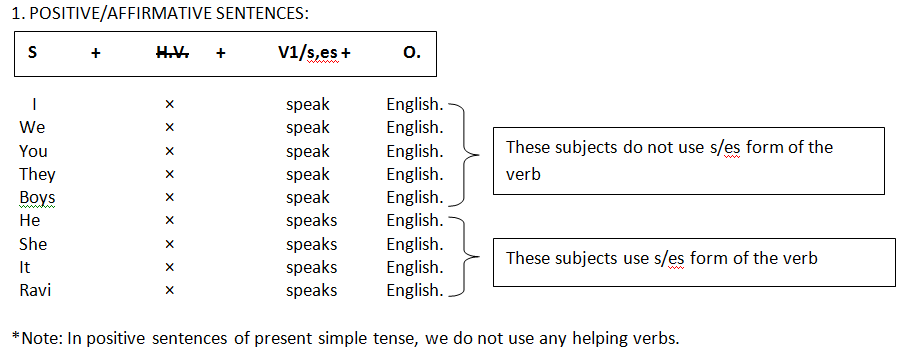
What is Present Simple Tense:=> The Simple Present Tense when an Action is happening right now, or when it happens Daily.

  1. A Universal truth: – The earth moves around the Sun.
  2. A Routine or Habitual action: – Hari plays cricket daily.
  3. A Ritual: – Indians celebrate many festivals.
  4. Likes or Dislikes: – She likes roses.
  5. A Proverb: – A burnt child dreads the fire.
  6. To describe duties of Professionals: – A doctor treats the patients.

Formula:-

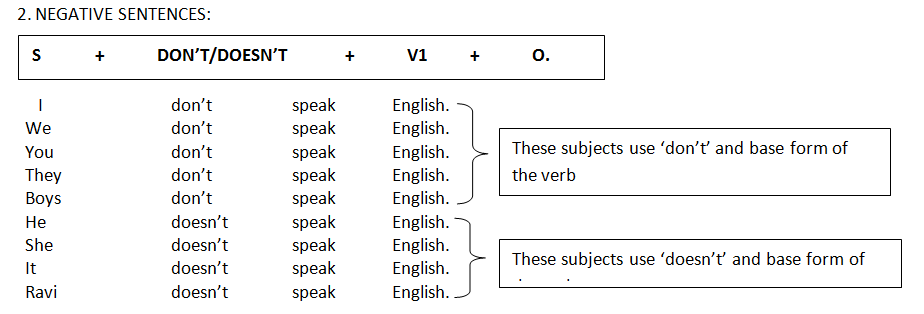
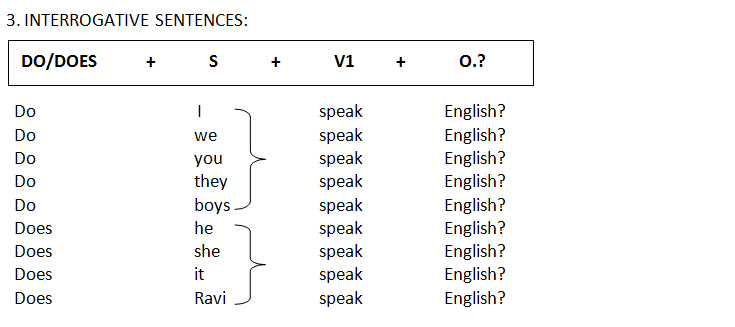
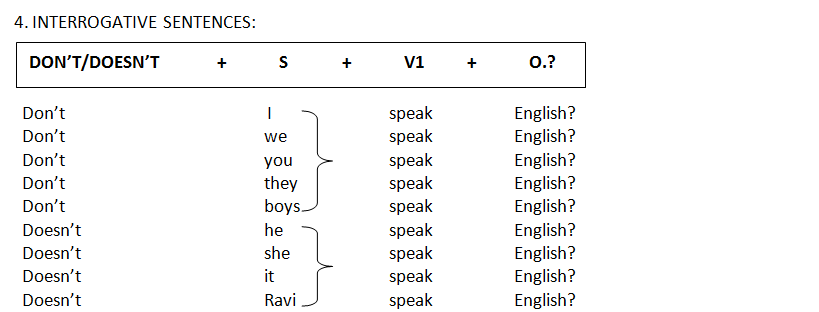
* All the subjects which do not use s/es form of the verb, we use DO and base form of the verb and the subjects which use s/es form of the verb, we use DOES and base form of the verb with them.

We can put any W-H words before interrogative and interrogative formulae.

Future Perfect Tense

                                                           Future Perfect Tense


In this tutorial, we will learn about  Future Perfect  Tenses

Prerequisites

Before starting with this tutorial we assume that you are best aware of the following  topics:

  • Nouns.
  • Pronouns.
  • Verbs.
  • Adjectives.
  • Adverbs.
  • Prepositions.
  • Conjunctions.
  • Interjections.

Future Perfect Tense refers to:

  1. An action of future that will be completed by the time: This function will have ended by 10pm.
  2. An action that we expect, will get completed in future: I will have completed my schooling in next year.

Formula:-

  1. POSITIVE SENTENCES:
S              +             WILL/SHALL       +             HAVE    +             V3           +             O.

I                      shall                               have                done      homework before 2 o’clock.
We                 shall                                have               done      homework before 2 o’clock.
You                will                                  have               done      homework before 2 o’clock.
They              will                                  have               done      homework before 2 o’clock.
Boys              will                                  have               done      homework before 2 o’clock.
He                  will                                  have               done      homework before 2 o’clock.
She                will                                  have               done      homework before 2 o’clock.
It                    will                                  have               done      homework before 2 o’clock.
Ravi               will                                  have               done      homework before 2 o’clock.

  1. NEGATIVE SENTENCES:
S              +             WON’T/SHAN’T         +       HAVE    +             V3           +                O.

I                               shan’t                        have                      done      homework before 2 o’clock.
We                         shan’t                         have                      done      homework before 2 o’clock.
You                        won’t                          have                      done      homework before 2 o’clock.
They                      won’t                          have                      done      homework before 2 o’clock.     Boys                      won’t                          have                      done      homework before 2 o’clock.
He                          won’t                          have                      done      homework before 2 o’clock.
She                        won’t                          have                      done      homework before 2 o’clock.
It                             won’t                         have                      done      homework before 2 o’clock.
Ravi                        won’t                         have                      done      homework before 2 o’clock.

  1. INTERROGATIVE SENTENCES:
WILL/SHALL       +             S              +             HAVE    +             V3           +             O.?

Shall                      I                             have                   done     homework before 2 o’clock?
Shall                      we                         have                   done     homework before 2 o’clock?
Will                        you                        have                  done     homework before 2 o’clock?
Will                        they                       have                  done     homework before 2 o’clock?                    Will                        boys                      have                  done      homework before 2 o’clock?
Will                        he                          have                  done      homework before 2 o’clock?
Will                        she                        have                  done      homework before 2 o’clock?
Will                         it                           have                  done      homework before 2 o’clock?
Will                         Ravi                      have                  done      homework before 2 o’clock?

  1. INTERROGATIVE SENTENCES:
WON’T/SHAN’T           +             S              +             HAVE    +             V3           +                O.?

Shan’t                              I                              have                 done      homework before 2 o’clock?
Shan’t                              we                          have                 done      homework before 2 o’clock?
Won’t                               you                        have                 done      homework before 2 o’clock?
Won’t                              they                        have                 done      homework before 2 o’clock?    Won’t                              boys                       have                 done      homework before 2 o’clock?Won’t                               he                          have                 done      homework before 2 o’clock?
Won’t                              she                         have                 done      homework before 2 o’clock?
Won’t                              it                             have                 done      homework before 2 o’clock?
Won’t                              Ravi                        have                 done      homework before 2 o’clock?

Rules:

  1. I, we –              shall
  2. Other subjects – will

NOTE: According to modern English rule, we can use WILL with I and WE also. It means if we do not use SHALL, it would not be considered as a grammatical mistakes.

Future Continuous Tense

                                                                        Future Continuous Tense

In this tutorial, we will learn about  Future Continuous Tenses

Prerequisites

Before starting with this tutorial we assume that you are best aware of the following  topics:

  • Nouns.
  • Pronouns.
  • Verbs.
  • Adjectives.
  • Adverbs.
  • Prepositions.
  • Conjunctions.
  • Interjections.

Future Continuous Tense refers to:

  1. An action that has not started yet but it will: Our plan will be working this time.
  2. An action which we think that will keep going on in future: This tree will be giving fruits.
  3. An action which is predicted for future and which will continue for a period of time: Our team will be performing well in this series.

Formula:-

  1. POSITIVE SENTENCES:
S              +             WILL/SHALL       +             BE           +             V+ing    +             O.

I                            shall                                       be                          earning                 a lot of money.
We                        shall                                       be                          earning                 a lot of money.
You                       will                                         be                          earning                 a lot of money.
They                     will                                         be                          earning                 a lot of money.
Boys                     will                                         be                          earning                 a lot of money.
He                         will                                         be                          earning                 a lot of money.
She                       will                                         be                          earning                 a lot of money.
It                            will                                         be                          earning                 a lot of money.

  1. NEGATIVE SENTENCES:
S              +         WON’T/SHAN’T          +        BE           +        V+ing    +            O.

I                             shan’t                       be                           earning                 a lot of money.
We                        shan’t                       be                           earning                 a lot of money.
You                       won’t                        be                           earning                 a lot of money.
They                     won’t                        be                           earning                 a lot of money.
Boys                     won’t                        be                           earning                 a lot of money.
He                         won’t                        be                           earning                 a lot of money.
She                       won’t                        be                           earning                 a lot of money.
It                            won’t                       be                           earning                 a lot of money.

  1. INTERROGATIVE SENTENCES:
WILL/SHALL       +             S              +             BE           +             V+ing    +             O.?

Shall                                      I                              be                          earning                 a lot of money?
Shall                                      we                          be                          earning                 a lot of money?
Will                                        you                        be                          earning                 a lot of money?
Will                                        they                       be                          earning                 a lot of money?
Will                                        he                          be                           earning                 a lot of money?
Will                                        she                        be                          earning                 a lot of money?
Will                                        it                            be                           earning                 a lot of money?
Will                                        Ravi                       be                           earning                 a lot of money?

  1. INTERROGATIVE NEGATIVE SENTENCES:
WION’T/SHAN’T              +             S              +             BE           +             V+ing    +             O.?

Shan’t                                  I                            be                          earning                 a lot of money?
Shan’t                                  we                        be                          earning                 a lot of money?
Won’t                                  you                       be                          earning                 a lot of money?
Won’t                                  they                      be                          earning                 a lot of money?
Won’t                                  he                         be                          earning                 a lot of money?
Won’t                                  she                       be                          earning                 a lot of money?
Won’t                                  it                           be                          earning                 a lot of money?
Won’t                                  Ravi                      be                          earning                 a lot of money?

Rules:

  1. I, we –              shall
  2. Other subjects – will

NOTE: According to modern English rule, we can use WILL with I and WE also. It means if we do not use SHALL, it would not be considered as a grammatical mistakes.

Past Perfect Continuous Tense 

                                         Past Perfect Continuous Tense 

Past Perfect Continuous Tense refers to:

  1. An action that had started in past and kept going on for a particular time: We had been writing this book since year 2020.
  2. In this tense, we mention duration of time of the action: I had been working in this institution for three years.
  3. An action that had ended at the time of speaking: My country had been keeping a close watch over the vaccination data. (now, it is over)

Formula:

  1. POSITIVE/AFFIRMATIVE SENTENCES:
S   +    HAD   +   BEEN   +        V+ing   +    O.   +   SINCE/FOR/TILL   +   TIME.

I                had              been        playing     chess               since               2 o’clock.
We           had              been        playing     chess               since               2 o’clock.
You          had              been        playing     chess               since               2 o’clock.
They        had              been        playing     chess               since               2 o’clock.
Kids         had              been        playing     chess               since               2 o’clock.
He           had              been        playing      chess               since               2 o’clock.
She          had              been        playing     chess               since               2 o’clock.
It              had              been        playing     chess               since               2 o’clock.
Ravi         had              been        playing     chess               since               2 o’clock.

  1. NEGATIVE SENTENCES:
S   +      HADN’T   +   BEEN   +   V+ing   +    O.   +   SINCE/FOR   +   TIME.

I               hadn’t             been        playing     chess          since               2 o’clock.
We          hadn’t             been        playing     chess          since               2 o’clock.
You         hadn’t             been        playing     chess          since               2 o’clock.
They       hadn’t             been        playing     chess          since               2 o’clock.
Kids        hadn’t             been        playing     chess          since               2 o’clock.
He          hadn’t             been        playing     chess          since                2 o’clock.
She        hadn’t             been        playing     chess           since                2 o’clock.
It            hadn’t             been        playing     chess           since                2 o’clock.
Ravi       hadn’t             been        playing     chess           since                2 o’clock.

  1. INTERROGATIVE SENTENCES:
HAD   +     S      +   BEEN   +   V+ing   +    O.   +   SINCE/FOR   +   TIME?

Had               I               been        playing     chess               since               2 o’clock?
Had               we           been        playing     chess               since               2 o’clock?
Had               you         been        playing     chess               since               2 o’clock?
Had               they        been        playing     chess               since               2 o’clock?
Had               kids        been        playing     chess               since               2 o’clock?
Had               he           been        playing     chess               since               2 o’clock?
Had               she         been        playing     chess               since               2 o’clock?
Had               It             been        playing     chess               since               2 o’clock?
Had               Ravi        been        playing     chess               since               2 o’clock?

  1. INTERROGATIVE NEGATIVE SENTENCES:
HADN’T   +          S      +       BEEN   +      V+ing   +      O.   +   SINCE/FOR   +   TIME?

Hadn’t                         I               been       playing               chess         since                  2 o’clock?
Hadn’t                         we          been        playing               chess         since                  2 o’clock?
Hadn’t                         you        been        playing               chess         since                  2 o’clock?
Hadn’t                         they       been        playing               chess         since                  2 o’clock?
Hadn’t                         kids        been        playing               chess         since                  2 o’clock?
Hadn’t                         he           been        playing               chess        since                  2 o’clock?
Hadn’t                         she         been        playing               chess        since                  2 o’clock?
Hadn’t                         it             been        playing               chess        since                  2 o’clock?
Hadn’t                         Ravi        been        playing               chess        since                  2 o’clock?

NOTE: In this tense, we also use ending time of the action we do. To show ending time, we use “TILL” and it doesn’t matter whether the time is point of time or period of time .

Past Perfect Tense

                                                                        Past Perfect Tens

In this tutorial, we will learn about  Past  Perfect Tenses

Prerequisites

Before starting with this tutorial we assume that you are best aware of the following  topics:

  • Nouns.
  • Pronouns.
  • Verbs.
  • Adjectives.
  • Adverbs.
  • Prepositions.
  • Conjunctions.
  • Interjections.

Past Perfect Tense refers to:

  1. An action that was over before another action: The shop had closed before I reached there.
  2. Report a complete action in past: He told me that he had lost his job previous year.
  3. An expected action that did not happen in past: They had wanted to come with me but could not.

Formula:-

  1. POSITIVE/AFFIRMATIVE SENTENCES:
S              +             HAD       +             V3           +             O.

I                         had                    done                 homework.
We                    had                    done                 homework.
You                   had                    done                 homework.
They                 had                    done                 homework.
Children          had                    done                 homework.
He                    had                    done                 homework.
She                  had                    done                 homework.
It                      had                    done                 homework.
Rahu               had                    done                 homework.

  1. NEGATIVE SENTENCES:
S              +             HADN’T                +             V3           +             O.

I                             hadn’t                                    done                     homework.
We                         hadn’t                                   done                     homework.
You                        hadn’t                                   done                     homework.
They                      hadn’t                                   done                     homework.
Children               hadn’t                                   done                     homework.
He                          hadn’t                                   done                     homework.
She                        hadn’t                                   done                    homework.
It                             hadn’t                                  done                    homework.
Rahul                     hadn’t                                  done                    homework         .

3.INTERROGATIVE SENTENCE:

HAD                       +             S              +             V3           +             O.?

Had                                        I                              done                     homework?
Had                                        we                          done                      homework?
Had                                        you                        done                      homework?
Had                                        they                       done                      homework?
Had                                        children                done                      homework?
Had                                        he                           done                      homework?
Had                                        she                         done                      homework?
Had                                        it                             done                      homework?
Had                                        Ravi                        done                      homework?

  1. INTERROGATIVE NEGATIVE SENTENCES:
HADN’T+             +             S              +             V3           +             O.?

Hadn’t                                  I                              done                     homework?
Hadn’t                                  we                          done                     homework?
Hadn’t                                  you                        done                      homework?
Hadn’t                                  they                       done                      homework?
Hadn’t                                  children                done                      homework?
Hadn’t                                  he                           done                     homework?
Hadn’t                                  she                         done                     homework?
Hadn’t                                  it                             done                     homework?
Hadn’t                                  Ravi                        done                     homework?

Rules:
We use ‘HAD’ as a helping verb with all subjects in this tense.
We can put any W-H words before interrogative and interrogative formulae.