Category Archives: Learn English

Learn English

Past Simple Tense

                                                               Past Simple Tense

In this tutorial, we will learn about  Past Simple Tenses

Prerequisites

Before starting with this tutorial we assume that you are best aware of the following  topics:

  • Nouns.
  • Pronouns.
  • Verbs.
  • Adjectives.
  • Adverbs.
  • Prepositions.
  • Conjunctions.
  • Interjections.

Past Simple Tense refers to:

  1. An action that has happened in past and we describe in present: We celebrated my birthday joyfully.
  2. A habitual action in past or a past thought: I enjoyed a lot during my summer vacations.
  3. Narrate a story: once upon a time there lived a lion.
  4. A historical event: India won the world-cup twice in 1983 and 2011.

Formula:-

  1. POSITIVE/AFFIRMATIVE SENTENCES:
S              +             H.V.      +             V2           +             O.

I                                   ×                            spoke              English.
We                              ×                            spoke              English.
You                             ×                            spoke              English.
They                           ×                            spoke              English.
Boys                           ×                            spoke              English.
He                               ×                            spoke              English.
She                             ×                            spoke              English.
It                                  ×                            spoke             English.
Ravi                             ×                            spoke             English.

*Note: In positive sentences of past simple tense, we do not use any helping verbs.

  1. NEGATIVE SENTENCES:
S              +             DIDN’T  +             V1           +             O.

I                                   didn’t                   speak              English.
We                              didn’t                   speak              English.
You                             didn’t                   speak              English.
They                           didn’t                   speak              English.
Boys                           didn’t                   speak              English.
He                               didn’t                   speak              English.
She                             didn’t                   speak              English.
It                                 didn’t                   speak              English.
Ravi                            didn’t                   speak              English.

  1. INTERROGATIVE SENTENCES:
DID         +             S              +             V1           +             O.?

Did                                        I                             speak                    English?
Did                                       we                          speak                    English?
Did                                       you                        speak                    English?
Did                                       they                       speak                    English?
Did                                       boys                      speak                    English?
Did                                       he                          speak                    English?
Did                                       she                        speak                    English?
Did                                       it                            speak                    English?
Did                                       Ravi                       speak                    English?

  1. INTERROGATIVE SENTENCES:
DIDN’T  +             S              +             V1           +             O.?

Didn’t                  I                       speak                    English?
Didn’t                  we                   speak                    English?
Didn’t                  you                  speak                    English?
Didn’t                  they                 speak                    English?
Didn’t                  boys                speak                    English?
Didn’t                  he                    speak                    English?
Didn’t                  she                  speak                    English?
Didn’t                  it                      speak                    English?
Didn’t                  Ravi                 speak                    English?

Rules:

  1. Second form of the verb will be used with positive sentences only.
  2. Here We use the same form of the verb with all subjects.
  3. We do not use any H.V. in positive sentence, but we use DID as a helping verb in other sentences.
  4. Do not use V2 when we use DID as a helping verb. We use DID+V1 form of the verb.
Structure of different types of sentences

In this tutorial, we will learn about Structure of different types of sentences

Prerequisites

Before starting with this tutorial we assume that you are best aware of the following  topics:

  • Nouns.
  • Pronouns.
  • Verbs.
  • Adjectives.
  • Adverbs.
  • Prepositions.
  • Conjunctions.
  • Interjections.

Let us recall what we have learnt in Lesson- 2 about a sentence and its types.
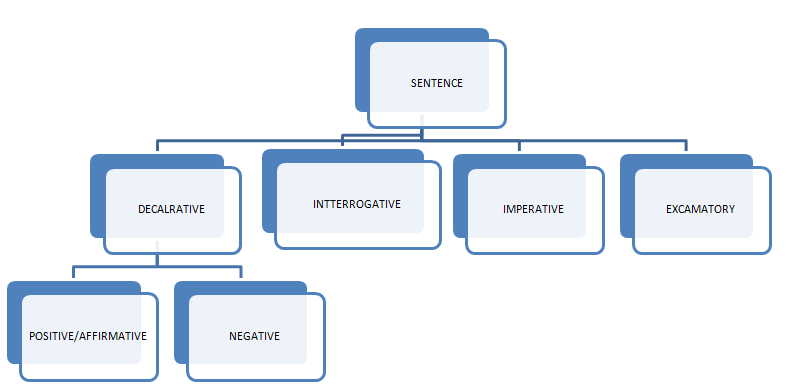
There are four types of sentences on the basis of their meaning.
Declarative (Positive and negative)
Interrogative (yes/no type questions and W-H questions)
Imperative (command, request and suggestion)
Exclamatory (expressions)
These all types are sentence follow different patterns of using parts of sentences.
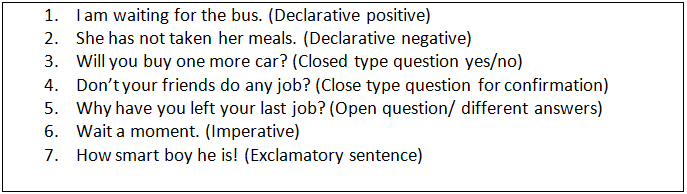
Let us see some examples of each type of sentences.

  1. I can speak English. (Subject-I, Helping verb-can, Main verb-speak and English-object)
  2. I cannot speak English. (Subject, Helping verb+not, Main verb, and Object)
  3. Can I speak English? (Helping verb, Subject, Main verb and Object)
  4. Can I not speak English? (Helping verb, Subject, Not, Main verb and Object)
  5. How can I speak English? (W-H words, Helping verb, Subject, Main verb and Object)
  6. Please speak in English only. (Request, Main verb and object)
  7. What a fluent English speaker you are! (expression, Object, Subject and Helping verb)

Above, all sentences using all the parts of sentences at different places and giving different meaning.
Now, let us see their structures with examples:

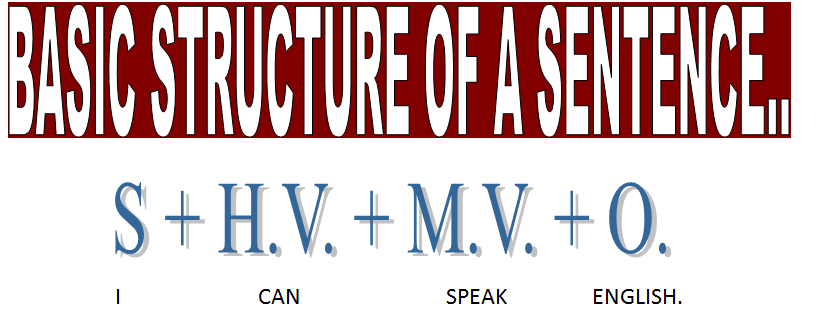
(S – subject, H.V. – helping verb, M.V. – main verb and O – object).

  1. Positive sentence:
S              +             H.V.       +             M.V.      +             O.

I                        CAN             SPEAK               ENGLISH.

  1. Negative sentence:
S              +             H.V. N’T   +          M.V.      +             O.

I                        CAN’T             SPEAK                   ENGLISH.

  1. Interrogative sentence: 
H.V.       +             S              +             M.V.      +             O. ?

CAN                   I                   SPEAK                   ENGLISH?

  1. Interrogative negative sentence:
H.V.N’   +             S              +             M.V.      +             O. ?

CAN’T              I                       SPEAK              ENGLISH?

  1. W-H question sentence:
W-H       +             H.V.      +             S              +             M.V.      +             O. ?

HOW              CAN                  I                          SPEAK                   ENGLISH?

  1. Imperative sentence: This type of sentences do not use any Subject or Helping Verb. 
M.V.      +             O.

STOP             THE CAR.

But, in negative form of imperative sentences, ‘Don’t’ as a helping verb is used.

DON’T   +             M.V.      +             O.

DON’T            TELL              A     LIE.

  1. Exclamatory sentence:
INTERJECTION !        +  WHAT/HOW  +     O.    +   S    +   H.V. !

WOW !                      WHAT              A CAR    YOU     HAVE!

So, now you must have understood the placement of a subject, helping verb, main verb and an object.

From lesson number 1st to 4th, we have learnt theoretical grammar in which we have seen definitions, types and examples. In practical English (we us in speaking), these things are not asked by anyone, but, we should have knowledge of them. In competitive exams, they ask you a deep knowledge of English grammar including both theoretical and practical.

So let us begin theoretical portion of English grammar….

End of Theoretical Grammar..

Sentences and Types of sentences.

In this tutorial, we will learn about Sentences and Types of Sentences.

Prerequisites

Before starting with this tutorial we assume that you are best aware of the following  topics:

  • Nouns.
  • Pronouns.
  • Verbs.
  • Adjectives.
  • Adverbs.
  • Prepositions.
  • Conjunctions.
  • Interjections.

In the previous lesson, we have learned about words and types of words(Parts of speech). Now, in this lesson, we will learn about the arrangement of words, according to our needs, which we call a sentence.

Sentence:

A sentence is a meaningful order of words we use to communicate our message to the listeners.

Examples:

1.I am learning English grammar.
2.He does not listen to his parents.
3.Please try to understand.
4.Will you marry me?
These all examples contain number of words in a proper order to communicate a meaning in a different manner.
Let us take some more examples:
5.A monkey on the tree
6.A big yellow house
7.In the car
In the above examples 5, 6, and 7
Do you see a proper sequence of words? Your answer must be a Yes.
Do you get a complete meaning of this arrangement? Your answer must be a No.
So, will we call them a sentence? No. Why?
Because, we do not get any proper meaning from any of the examples.
Such arrangements are not called a sentence, even if they have a proper arrangement, they are called Phrases (a part of the sentence).

                                                       Types of sentences

On the basis of nature, we can classify a sentence in to the following categories:

  1. Simple sentence
  2. Compound sentence
  3. Complex sentence

Let us understand them……!

  1. Simple sentence: a simple sentence contains a subject and a verb in it, makes a complete sense and does not depend on another sentences.

Examples:

  1. I will punish you for this.
  2. Honesty is the best policy.
  3. Hard work pays you back.
  4. Compound sentence: A compound sentence is made up of two simple sentences using any conjunctions.

Examples:

  1. I) He likes football. (simple sentence)
  2. II) He likes cricket. (simple sentence)
  • He likes cricket and football. (compound sentence)
  1. I) She is my best friend. (simple sentence)
  2. II) I respect her a lot. (simple sentence)
  • She is my best friend and I respect her a lot. (compound sentence)
  1. Complex sentence: A complex sentence has a simple sentence (independent) and a subordinate clause (dependent sentence).

Examples:

    1. Some people eat less     so that they could maintain their health.

(Independent)                            (Dependent)

2. When I was a young boy,    I had lost my favorite toy.

(Dependent)                     (Independent)

On the basis of meaning, sentences have been classified in four categories:

  1. Declarative sentence or A statement
  2. Interrogative
  3. Imperative
  4. Exclamatory sentence

Now let us understand them in detail.

  1. Declarative Sentence:  A sentence which declares something to happen or not is called a Statement or Declarative Sentence.

A Declarative sentence may be an ‘assertion’ or ‘negation’. So, in this way, declarative sentence can be of two types:

  1. Positive or Affirmative or a statement of assertion: this type of sentences gives us a positive meaning.
  2. I love my country. (Positive meaning)
  3. Negative sentence: a sentence which gives is a negative meaning.
  4. I do not love my country. (Negative meaning)
  5. Interrogative sentence: A sentence which is used to ask a question is called an Interrogative sentence.
  6. Are you going somewhere?
  7. Don’t you understand English?
  8. Why are you crying?
  9. Who doesn’t play cricket?

So, if we try to answer question 1 and 2, our answers may me either in yes or no. But question 3 and 4 cannot be answered in yes or no, we have to answer them in a description.

Therefore, on this basis, we can say that Interrogative sentences are of two types:

  1. Yes/no type questions or closed type questions:

This type of question has only two options to answer, yes/no.

Example 1 and 2

  1. Descriptive questions or W-H questions or open questions:

This type of questions cannot be answered in yes or no. Since such questions have many ways to answer; therefore, we call them open questions or descriptive questions.

Example 3 and 4.

  1. Imperative sentence: A sentence which is used to ask a request or an order or a command or a suggestion is called an imperative sentence.

Examples:

  1. Please help me. (request)
  2. Shut your mouth up. (order)
  3. Don’t talk on phone while driving a car. (suggestion)
  4. Turn left. (command)
  5. Exclamatory sentence: A sentence which is used to show our expressions of joy, sorrow, fear etc is called an exclamatory sentence.

This type of sentences takes an exclamation mark in the last of the sentence.

Example:

  1. Wow! What a car!
  2. How dirty boy you are!
  3. Bravo! You have made it.

Simple, compound and complex sentences will be studied in details in lesson number 14.

Review:

Interjection

In this tutorial , we will learn about Interjection.

Prerequisites

Before starting with this tutorial we assume that you are best aware of the following topics.

  • Noun.
  • Pronoun.
  • Verb.
  • Adjective.
  • Adverb.
  • Preposition.
  • Conjunction.

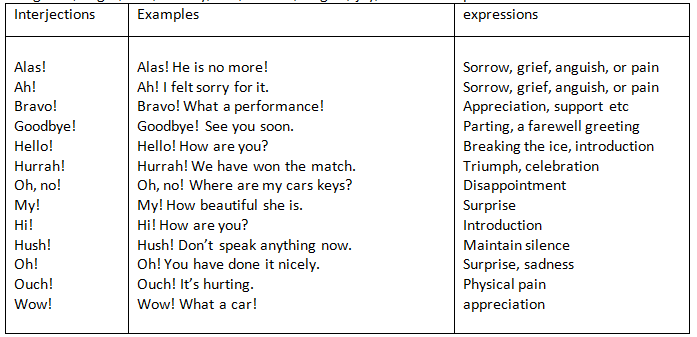
Let’s see some examples:

  1. Oh! What have you done this?
  2. Wow! What a car.
  3. Goodbye! See you soon.

In the above examples, the words written like; oh!, wow!, goodbye!…, with exclamation mark are called Interjections.

Definition: An Interjection is one of the parts of speech which shows sudden expressions and feeling of a being.

Feelings like; anger, fear, anxiety, like, dislikes, disgust, joy, love and surprise.

So, now we have reached to the end of introduction of parts of speech…..!

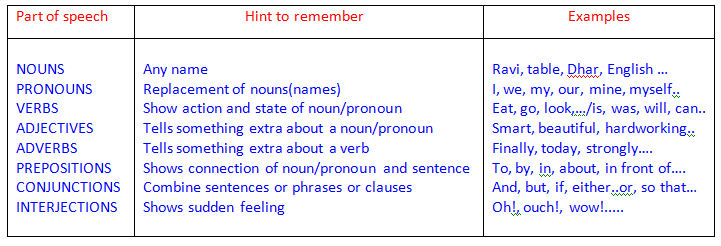
Let us take a small review of them.


Parts of speech

In this tutorial, we will learn about  Parts of speech.

Prerequisites

Before starting with this tutorial we assume that you are best aware of the following topics.

  • Alphabet.
  • word.
  • synonym
  • antonym.

What Is Parts of speech?

A Part of speech  is a categorization of words that have alike grammatical properties.

Parts of speech

In English there are 8 parts of speech.
They are :

    1. Noun
    2. Pronoun
    3. Verb
    4. Adjective
    5. Adverb
    6. Preposition
    7. Conjunction and
    8. Interjection

Now let us try to understand these Parts of Speech and their functions one by one.

Noun.

In our lower classes we have learnt the definition of Noun as a Noun is the name of person, place or thing.
Just remember in the definition the person, place or thing is not a noun their names are nouns.
So in short  we can define a noun is following:
” Every name is called a Noun.

Examples :

‘David’, ‘England’, ‘friendship’, ‘class’ ,’table’,’dog’ and etc….

In general Nouns  are divided into main five categories:

  1. Common Noun.
  2. Proper Noun.
  3. Abstract Noun.
  4. Collective Noun and
  5. Material Noun.

Let’s understand the types of Noun one by one:

1.Common Noun

A Common Noun is a type of name which we use in general to show A category of things persons or places.

Example

‘boy’, ‘girl’, ‘child’, ‘river’,’ mountain’,’ city’, ‘villages’,’ books’ and etc…

The above example do not show the particular name of the things places or persons but which we use in general for a category.

‘These words are used commonly for a category that is why they are known as Common Nouns.

2.Proper Noun.

Proper Noun is a type of noun which we use to show a particular place, person or a thing. It shows an individual name.

Example:

‘David’,’India’,’Samsung’,’Times of India’,’Ganga’,’Himalaya’ and etc…

Note : The first letter of a proper noun is always written in a capital letter whether it is used in the beginning or in the end of the sentences.

3.Abstract Noun

An Abstract Noun is a type of noun that shows the name of emotions.

Example:

‘Courage’,’Happiness’,’Sadness,’Love’,’Anger’,and other names of our feelings.

4.Collective Noun

A Collective Noun is a type of noun that shows a name of a group.

Example:

‘Army’,’Class’,’Gang’,’Bunch’,’Bundle’,’School’,’Colony’,’Team’,’Party’ and etc…

5.Material noun

Material noun is a type noun which shows the name of the material by which a thing has been made up of.

Example:

‘Plastic’,’Gold’, ‘Wood’,’Cotton’,’Skin’,’Milk’,’Silver’,”Iron’,’Soil’,’Sand’ and etc…

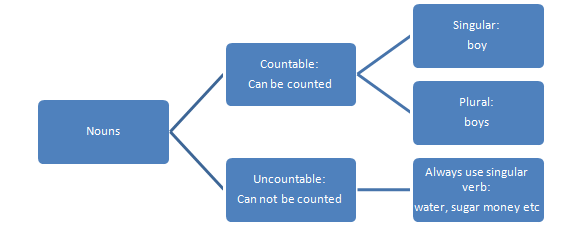
Classification on the basis of numbers, nouns have been categorized as following:

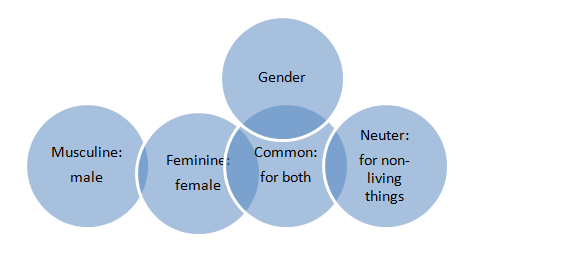
Classification on the basis of gender,Nouns have been categorized as following.


This is the classification on the basis of numbers and gender of the nouns.

Conjunctions

In this tutorial , we will learn about Conjunctions.

Prerequisites

Before starting with this tutorial we assume that you are best aware of.

Noun.
Pronoun.
Verb.
Adjective.
Adverb.
Preposition.

A conjunction is a word which is used to combine two or more than two sentences, phrases and clauses.

Example:

  1. I) I love cricket.
  2. II) I love football.

I love cricket and football.

  1. I) I play chess.
  2. II) My friends play chess.

I and my friends play chess.

  1. I) I beat him.
  2. II) He was disturbing me.

I beat him because he was disturbing me.

Clause         conj.                clause

In the above examples, the red words are combining two sentences; therefore they are called conjunctions.

Note: The sentences connected with conjunctions are called clauses.

Types of conjunctions:

  1. General conjunctions: usually single word: and, but, if, because……etc.
  2. Compound conjunctions: more than one word to make a single conjunction: so that, on condition that, provided that…….etc.
  3. Co-relative conjunctions: are used in parts: so….that, not only…..but also, either….or etc.
  4. Relative conjunctions: shows relations between two sentences: who, whoever, whatever etc.

On the basis of functions, conjunctions are of the following types:

  1. Conjunction of addition: is used to join two sentences of similar type.

You and I can do this.

  1. Conjunction of contrast: is used to combine the sentences of opposite nature.

Ravi likes mango but I don’t.

  1. Conjunction of choice: is used to make choices among the options.

Either you or your friends are guilty.

  1. Conjunction of reasoning: is used to show reason.

I beat him because he was disturbing me.

  1. Conjunction of condition: is used to show condition.

If you help me now, I will reward you with gold.

Preposition

In this tutorial , we will learn about Preposition.

Prerequisites

Before starting with this tutorial we assume that you are best aware of.

Noun.
Pronoun.
Verb.
Adjective.
Adverb.

Let us talk about Preposition. To understand the concept of Prepositions, let us see some examples:

1.We are in the bus.
2.We celebrate Independence Day on 15th August every year.
3.We are going to.

In the above sentences, ‘in, on, and to, are prepositions.

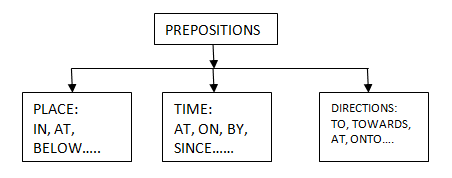
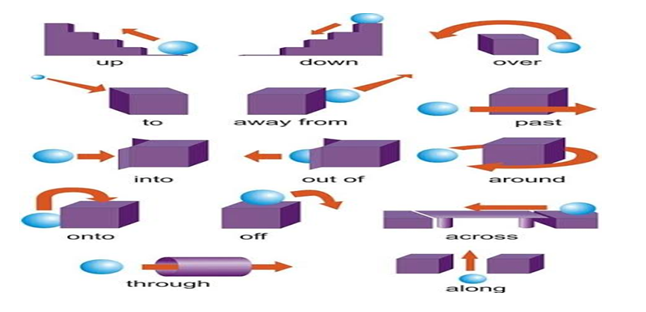
Prepositions are used to show time, place and direction.

Definition: “A preposition is a word which relates a noun/pronoun with a sentence or a phrase”.

Prepositions are used before a noun or a pronoun to indicate time, place or directions.

Type Of Prepositions:

There are four types of Prepositions:

  1. Simple preposition: at, on, by, to, with etc…(usually small words)
  2. Compound prepositions: among, between, below etc….(a little bigger one)
  3. Phrase prepositions: in front of, by the reason of, on behalf of etc….(which is made up of two or more than two words..)
  4. Participle prepositions: barring, leaving, notwithstanding etc…. (V1+ing).

Prepositional Phrase:

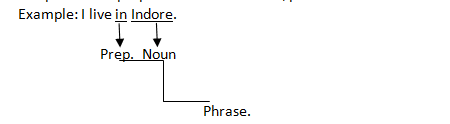
The pair of the preposition and the noun/pronoun connected with it is called a prepositional phrase.

Further details will be explained in our Lesson 13.


Adverbs

in this tutorial , we will learn about Adverbs.

Prerequisites

Before starting with this tutorial we assume that you are best aware of.

Noun.
Pronoun.
Verb.
Adjective.

Let s see some examples:

  1. I dance nicely.
  2. He came to the meeting very late.
  3. My father is going to buy a new car tomorrow.

In above example, we can see the words ‘nicely, very late, tomorrow and really’ are showing “How the action is taking place, when the action is taking place and how nice the man is”  these all words which are telling something about the actions, place, time etc. are known as Adverbs.

So, in short, we can say that any word that modifies any verb, adjective or adverb as well is called an adverb.

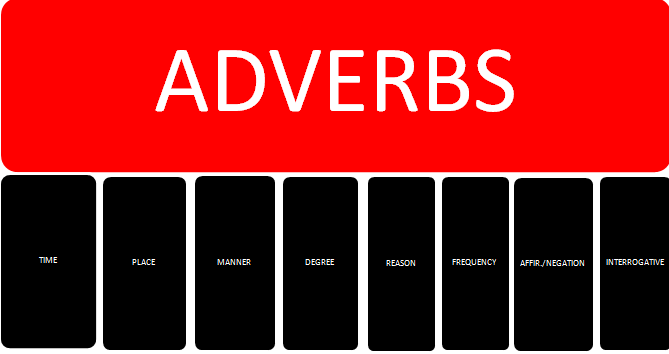
We can classify adverbs in the following categories:

1.Adverbs of Time: shows time of action: now, then, today…..

2.Adverbs of Place: shows place of action: here, there….

3.Adverbs of Manner: shows how the action is going on: beautifully, nicely….

4.Adverbs of degree: shows how much action is done: finally, eventually…..

5.Adverbs of reason: shows reason of action: thus, that is why, why, hence….

6.Adverbs of affirmation/negation: surely, no, never….

7.Interrogative adverbs: used for asking questions about the action: how?, when?…..

8.Adverb of frequency: shows how often the action is done: always, seldom, often….


Adjectives

In this tutorial , we will learn about Adjective.

Adjectives

Now, let’s learn about Adjectives.
Adjectives are describing words for a noun or a pronoun.
All the words that tell something about a Noun or A pronoun are called adjectives.

Examples:

1. Ravi is a smart.
2.I have three.
3.Do you have some milk?
4.This is my
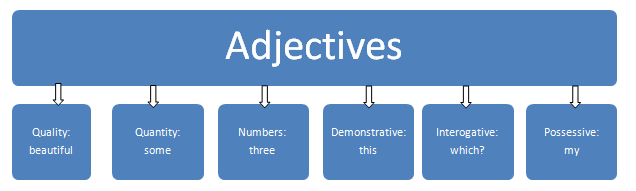
In the above examples, the underlined words are adjectives which are showing quality(smart), quantity( some), numbers( three) and possession (my).

So, in short, we can say that adjectives can be classified into following categories.

  • Adjectives of quality: She is a beautiful
  • Quantity of Adjectives : I have some good friends.
  • Adjectives of numbers: I saw three
  • Demonstrative adjectives: This car is mine.
  • Interrogative adjectives: Which subject will you prefer to teach?
  • Possessive adjectives: My father is a doctor.


Now, let’s learn about degree of Adjectives:

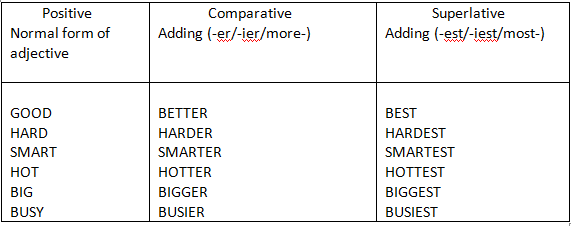
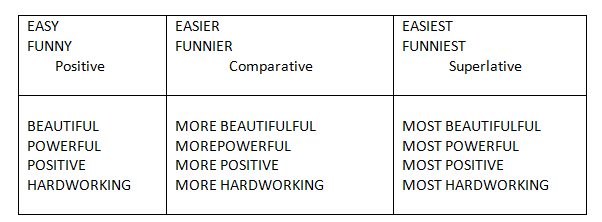
An adjective has three degrees of comparison:
Positive degree: when there is no comparison: He is a good boy.

Comparative degree: when the comparison takes place between two objects: She is                                                             more beautiful than her.
Superlative degree: when comparison takes place among more than two objects: She is the                                             most beautiful girl among all of us.
Let us see some more examples and understand adjectives…..!


Points to remember:

1.If an adjective has one or two syllables, we add +er and +est to form comparative and superlative respectively.

2.If an adjective ends with incomplete sound or pronunciation, the last letter is doubled and add +er and +est .to form comparative and superlative respectively.

3.If an adjective ends with a Y and before Y there is a consonant, then, Y is removed and

+ ier and +iest form comparative and superlative respectively.

4.If an adjective has more than three syllables, ‘more’ and ‘most’ are added to form comparative and superlative respectively.

As in adjective BEAUTIFUL, there are three syllables (beau-ti-ful) therefore, we have added MORE and MOST before the positive degree of it.

5.Main verbs in –ing form are also used as adjectives. As: a hardworking

6.If there are more than one adjectives in a single sentence or a phrase, there is a sequence has to be followed which is as following:

7.Quantity or number (determiners) 2. Quality or opinion, 3. Size, 4. Age, 5. Shape, 6. Colour, 7. Proper adjectives (place/belonging to) and 8. Purpose or qualifier.

Example: I love that really big old green antique car.


Verbs

In this tutorial, we will learn about Verbs.

All the words that show an Action and the Time of the action are called Verbs.
Verbs do not show only Action but Timing of the action as well.

1    go, come, take, feel, look, eat etc. (showing action).
is, are, was, can, shall, must etc. (showing timing of the action).
I am reading an English book.

Time     Action
In this way, we can say that a verb has two functions to show:

  1. Action:- known as Main Verb
  2. Time:-    known as Helping Verb

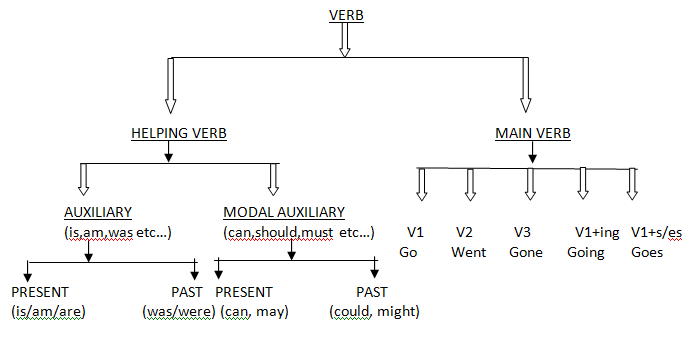
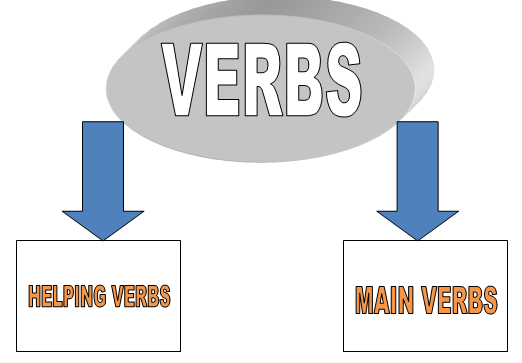
The following flowchart will help you to understand the classification of verbs:

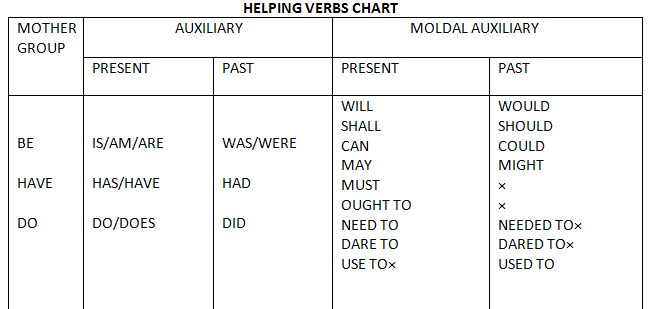
Now, let us have a look at how helping verbs formed and classified….!

This chart shows clearly how helping verbs have been classified.

*Here (×) shows the modals which are not in use or they do not exist in past forms.

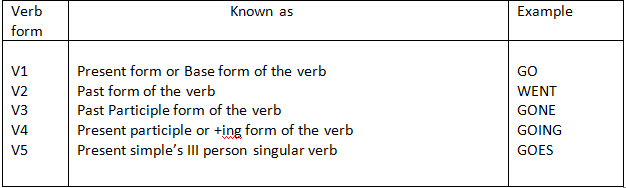
CLASSIFICATION OF MAIN VERBS

Main verbs have five basic forms,out of them three forms are ready-made forms while other two can be formed using first form of the verbs.

Further classification will be discussed in coming chapters…..!


Pronoun

In this tutorial, we will learn Pronoun.

Pronoun

In our daily life, we avoid repeating names of someone or something. Instead of calling name, we speak some other words that can replace those names(nouns), “These word which are used to avoid repetition of nouns  are called Pronouns”.

Examples:

  1. I play chess.
  2. We know English language.
  3. This is my car.

In the above examples, underlined words are called pronouns.
Now, let us learn ‘Types of Pronouns’:
Pronouns have been classified in the following categories:


1.Personal Pronoun: This is used for three persons, first person(I and We), second                                                         person(You) and third person(he, she, it, they)

This kind of pronoun is used at the place of a subject and an object, therefore,
This is of two types:

Subjective:     used at the place of a subject: I, we, you, they etc.
Sentence: We are reading now.
Objective: used at the place of an object: me, us, you, and them etc.
Sentence: He is cheating us.

2.Possessive Pronoun: This is used to show possession on something or someone.
Example: mine, ours, yours etc.
Sentence: These all books are mine.

3.Demonstrative Pronoun: This is used to point to some particular person or thing.

Example: This, That, These and Those.
Sentence: This is a fantastic idea.

4.Relative Pronoun: This is used to link phrases or clauses to another in a sentence:
Example: who, whom, whose, that etc.
Sentence: I know a person who can help you.

5.Interrogative Pronoun: This is used to ask a question about a noun or a pronoun itself.

Example:  Who, Whose, Whom, Which etc.
Sentence: Who is waiting for the bus?

6.Reflexive Pronoun: This is used to reflect a subjective pronoun. The “self” form of personal pronouns is called Reflexive Pronoun.

Example: myself, himself, ourselves etc.
Sentence: I can do it myself.

7.Indefinite Pronoun: This is used for the unknown number of subject(s) or object(s).

Examples: anybody, everybody, anyone, anything, something etc
Sentence: Anybody can come here and take this bag.

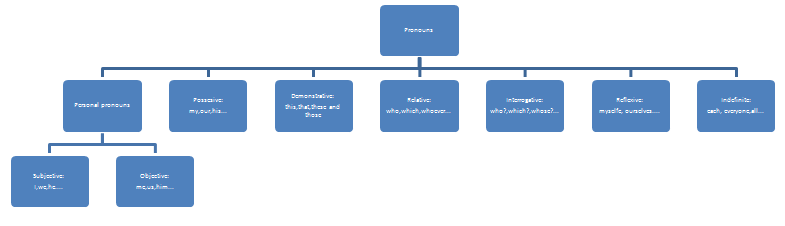
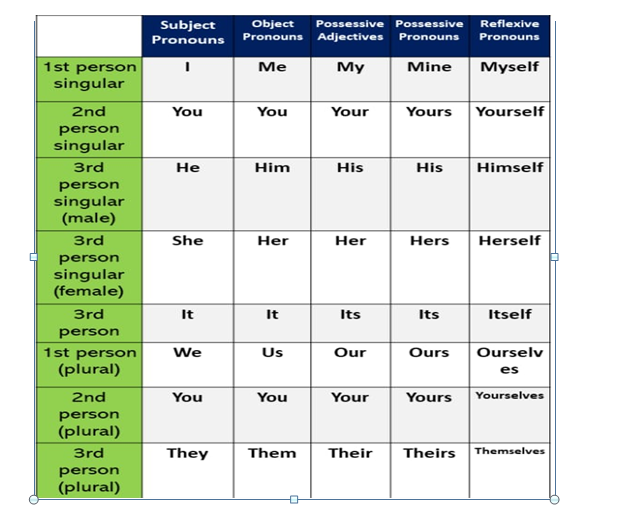
So, here is a chart of pronoun which will help you to understand pronouns.