Category Archives: SDLC

Software Development Life Cycle

Big Bang Model

Big Bang Model

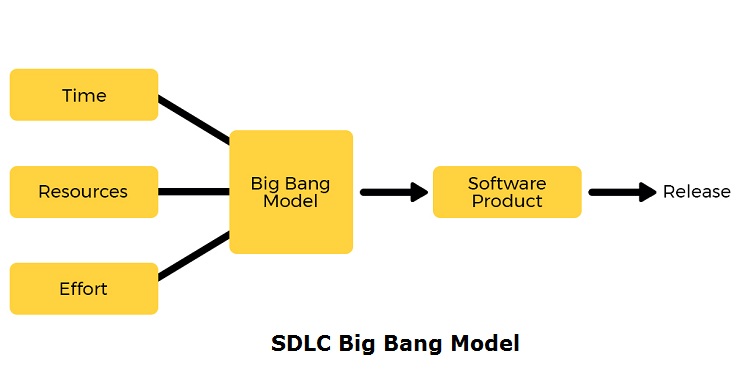
The Big Bang Model is the most straightforward model in the Software Development Life Cycle. It necessitates less preparation, more code or programming, and more cash. Because it is inspired by the Big Bang hypothesis, the model name depicts Big Bang. According to the hypothesis, following the Big Bang, a large number of galaxies, planets, and stars form gradually. Similarly, we combined time, effort, resources, and cash to create the finest software solution.

We did not follow any set process or technique in this model, although it did need some forethought. In this paradigm, we build software with time, effort, and resources, yet the outcome may or may not match the needs of the client (customer). This paradigm is not ideal for major software development or sophisticated projects since it is a high-risk model, but it may be used for temporary and experimental or tiny software.
SDLC-Big-Bang-Model

This paradigm is often appropriate for tiny projects with small development teams, such as one or two developers working together to construct a software application or just as a dummy project, and it is also good for academic, learning, or practice projects. It’s a excellent model for a software product if the requirements are unclear or unclear, and there is no delivery date for that software product.

Advantages Of Big Bang Model

  • It is a basic model that is straightforward to implement. It is a very easy approach to adopt because there are no Software development life cycle process steps required.
  • It takes minimal preparation. There is no need for extensive study and planning; simply begin coding. As a result, there is no need for planning, analysis, documentation, high-level design, and so on.
  • It needs fewer resources. This strategy is recommended for small software development projects with 1 to 2 developers collaborating to construct a product or simply as a fake project.
  • It is appropriate for modest jobs. Because there is no requirement for a staff and no SDLC process phases, it only handles minor projects.
  • It is inexpensive. This paradigm takes fewer resources to implement in software development.
  • It is cost-effective since it requires fewer resources, fewer developers, and fewer management costs.
  • Easily manageable. As a result, this model is simple to administer. It is suitable for modest, low-risk tasks.
  • It has no time constraint for the project, making it very flexible for developers: There is no deployment deadline for the software product, which relieves developers of the burden of developing the product.
  • It generates good developers, i.e. full stack developers: This paradigm assists newcomers or students in developing software coding skills in various technologies.

Disadvantages Of Big Bang Model

  • It is not appropriate for large or complex tasks. Because it is a high-risk model, we cannot utilize it to construct a large or complex project.
  • It is an Extremely Dangerous model. This methodology is dangerous since it requires less preparation and does not need following the SDLC process phases during software development.
  • It is characterized by uncertainty. Because the presence of the software product may or may not be used for business purposes, or because the product’s longevity is limited, it has an indeterminate character.
  • It is a low-cost model.
  • It is the worst model for long-term projects. For a lengthy or large

We focused on one of the SDLC Big Bang models. This is how we create a modest project for learning or at the university level. It is not appropriate for the software business to create a large project as a high-risk model. To produce a software product, the whole software industry now use the Agile approach. This article also discusses the Big Bang model’s advantages and disadvantages.
Spiral Model

Spiral Model

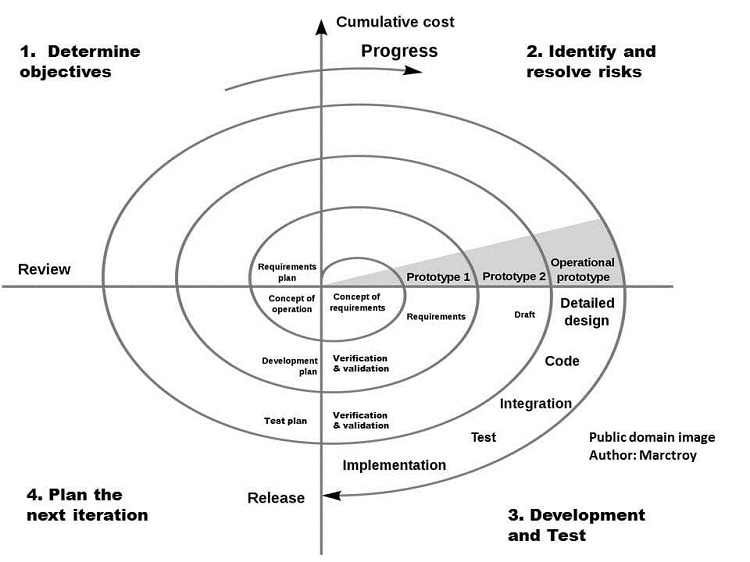
The spiral model, first presented by Boehm, is an evolutionary software process model that combines prototype model’s iterative characteristic with the linear sequential model’s regulated and systematic elements. It implements the possibility for quick creation of new software versions. The programmer is developed in a series of incremental releases using the spiral methodology. The supplementary release may be a paper model or prototype during the early rounds. Later cycles result in increasingly full versions of the designed system.

At each spiral, the Construct phase relates to the making of the original software product. In the baseline spiral, a POC (Proof of Concept) is constructed to get user feedback while the idea is still being considered and the design is being developed. Then, in successive spirals with greater clarity on requirements and design details, a functioning model of the programmer known as a build is created and assigned a version number.

The spiral lifecycle model has the advantage of allowing product elements to be put in as they become available or known. This ensures that no prior needs or designs are in conflict.

Phases of the Spiral model

Each spiral cycle is broken into four different steps:

  • Setting objectives: Each cycle in the spiral begins with the identification of the cycle’s goal, the numerous choices for accomplishing the aims, and the restrictions that exist.
  • Risk assessment and reduction: The cycle’s next step is to compute these numerous options depending on the goals and restrictions. The focus of evaluation at this stage is on the project’s risk perception.
  • Development and validation: The following stage is to create methods to address uncertainties and hazards. Benchmarking, simulation, and prototyping are examples of activities that may be included in this process.
  • Finally, the following move has been planned. The project is assessed, and the decision is taken whether to continue with the spiral for another term. If it is chosen to keep, plans for the following stage of the project are developed.

sdlc-boehm-spiral-model

The development stage is determined by the remaining hazards. For example, if performance or user-interface issues are prioritized , than the programmer development risks, the next stage may be an evolutionary development that includes creating a more thorough prototype to address the risks.

The spiral model’s risk-driven aspect allows it to handle any combination of a specification-oriented, prototype-oriented, simulation-oriented, or other type of approach. A critical component of the concept is that each phase of the spiral is followed by a review of all the goods generated during that cycle, as well as planning for the following cycle. The spiral model may be used for both development and upgrade projects.

When to use Spiral Model?

  • When delivery is necessary on a regular basis.
  • When the project is enormous and the needs are ambiguous and difficult
  • Changes may be required at any moment.
  • Projects with a large budget

Advantages Of Spiral Model

  • A significant degree of risk analysis is required.
  • This is useful for large, mission-critical initiatives.

Disadvantages Spiral Model

  • It might be an expensive model to utilize.
  • Risk analysis need extremely specialized knowledge.
  • It is ineffective for smaller tasks.

Agile Model

Agile Model

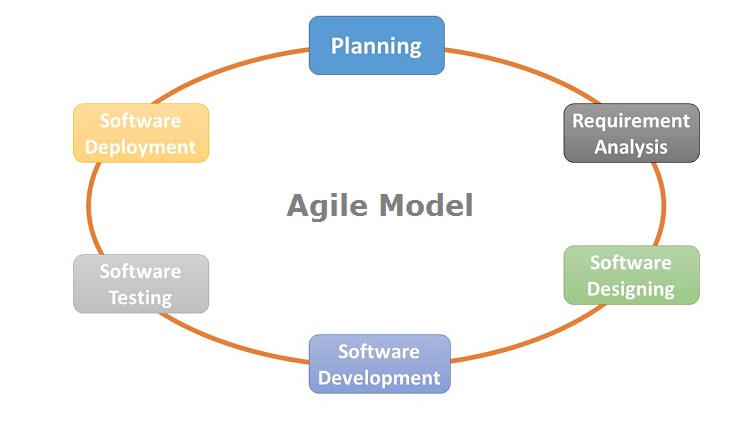
The Agile SDLC model is a hybrid of iterative and incremental process models, with a focus on process adaptation and customer satisfaction through the quick delivery of functional software. Agile methodologies divide a product into small incremental builds. Iterations of these builds are available. Each iteration normally lasts between one and three weeks.

Every iteration incorporates cross-functional teams working on many areas at the same time, such as:

  • Planning
  • Requirements Analysis
  • Design
  • Development
  • Unit Testing
  • Deployment

sdlc-agile-model

At the end of each iteration, a functional product is shown to the client and key stakeholders. According to the agile model, each project must be handled differently, and current techniques must be customized to best meet the project objectives. Tasks are grouped into time boxes (short time spans) in Agile to provide particular features for a release.

The technique is iterative, with each iteration delivering a viable software build. In terms of features, each build is incremental; the final version contains all of the features requested by the client.

The Agile thought process began early in software development and grew in popularity over time owing to its flexibility and adaptability. Rational Unified Process (1994), Scrum (1995), Crystal Clear, Extreme Programming (1996), Adaptive Software Development, Feature Driven Development, and Dynamic Systems Development Method (DSDM) are the most prominent agile techniques (1995). Following the publication of the Agile Manifesto in 2001, these are now generally referred to as Agile Methodologies.

Principles Of Agile Model

The Agile Manifesto principles are as follows:

  • Individuals and their interactions Self-organization and motivation are key in agile development, as are interactions like as co-location and pair programming.
  • Working software Demonstrating working software is seen to be the greatest way to communicate with clients in order to understand their needs, rather than relying just on documentation.
  • Customer cooperation because needs cannot be entirely acquired at the start of the project owing to a variety of variables, constant customer engagement is critical to obtaining correct product requirements.
  • Agile Development is focused on rapid reaction to change and continuous development.

Agile employs an adaptable approach in which there is no precise planning and there is simply clarity on future tasks in terms of what features must be produced. There is feature-driven development, and the team constantly responds to changing product needs. The product is tested regularly during release iterations, reducing the likelihood of severe failures in the future.

The backbone of this agile process is customer interaction, and open communication with little documentation is typical of an agile development environment. Agile teams collaborate closely with one another and are frequently based in the same geographical region.

Benefits of the Agile Model

The following are the benefits of the Agile Model:

  • It is a practical approach to software development.
  • Encourages collaboration and cross-training.
  • Functionality can be quickly built and shown.
  • The required resources are little.
  • Suitable for fixed or fluctuating needs
  • Provides partly workable solutions as soon as possible.
  • A good model for surroundings that change on a regular basis.
  • There are few regulations, and documentation is simple to implement.
  • Allows for concurrent development and delivery within a larger planned framework.
  • There is little to no preparation necessary.
  • Simple to use.
  • Allows developers to be more creative.

Prototype Model

Prototype Model

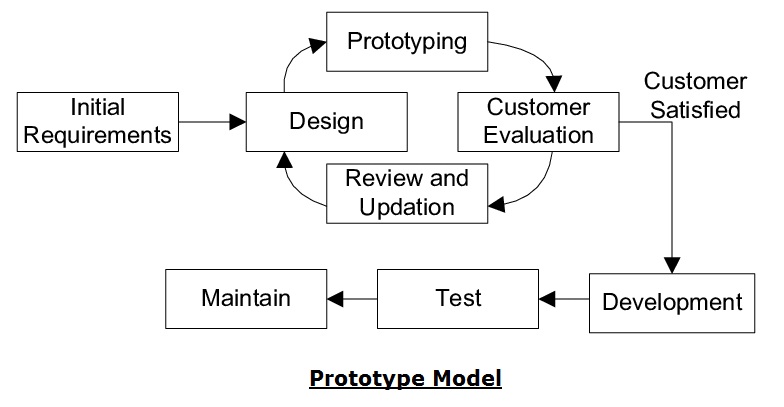
The main idea behind the Prototype Model is that rather of freezing the requirements before proceeding with design or coding, a throwaway prototype is developed to understand the needs. This prototype is based on the needs that are currently known. A prototype model is a model for software development. The client can acquire a “real feel” of the system by interacting with the prototype, since interactions with the prototype can help the customer better comprehend the requirements of the intended system. Prototyping is an appealing notion for complex and huge systems when there is no manual procedure or existing system to assist in defining the needs.

In this stage, the first Prototype is created, where the most basic needs are shown and user interfaces are supplied. These functionalities may not function exactly the same way in the final programmer built. While, in the prototype developed, workarounds are made to provide the same appearance and feel to the consumer.

Evolutionary prototyping, also known as breadboard prototyping, is centered on creating workable prototypes with limited capability at first. The produced prototype serves as the foundation for subsequent prototypes, upon which the full system is built. The well-known needs are included in the prototype by applying evolutionary prototyping, and the requirements are added as they are understood. Prototyping is used to allow consumers to review and test developer suggestions before they are implemented. It also aids in understanding user-specific requirements that may not have been considered by the developer during product creation.

The prototype is typically not a full system, and many of the intricacies are not included. The purpose is to offer general functioning to a system.

sdlc-prototype-model

Benefits of the Prototype Model

  • Users have an active role in the development.
  • Because this process includes a functioning model of the system, users have a better knowledge of the system being constructed.
  • Errors may be spotted at a far earlier stage.
  • Users may provide input more quickly, which leads to better solutions.
  • It is simple to identify missing functionality.
  • Functions that are perplexing or difficult to understand can be identified.
  • Validation of requirements, rapid implementation of an unfinished but working application.

Prototype model disadvantages

  • This leads to the implementation and then repair of a method of creating systems.
  • In practice, this process may enhance the system’s complexity when the scope of the system expands beyond the original goals.
  • Because the entire system was created, an incomplete application may result in the application not being used.
  • Incomplete or insufficient problem analysis

 When to Apply the Prototype Model

  • When the planned system requires extensive contact with end users, a prototype model should be employed.
  • Online systems and web interfaces with a high level of engagement with end users are typically best suited for the Prototype approach. It may take some time to develop a system that is simple to use and requires little training for the end user.
  • Prototyping ensures that that end users interact with the system on a regular basis and offer input, which is incorporated into the prototype to produce a usable system they are great for creating effective human-computer interaction systems.

Waterfall Model

Waterfall Model

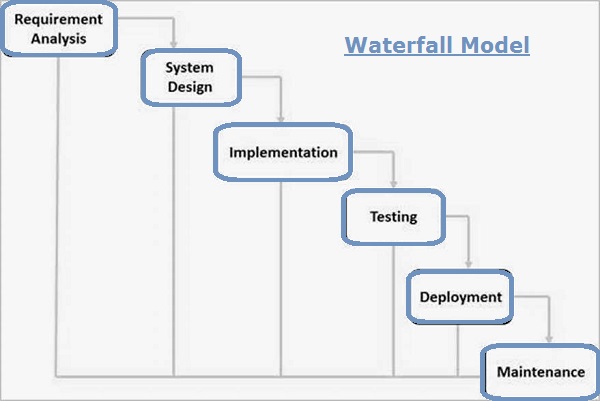
The waterfall model is a prominent method to the software development life cycle (SDLC) in software engineering and product development. It is a linear, sequential approach to the SDLC. The waterfall paradigm stresses a step-by-step development. Distinct endpoints or goals are specified for each step of development and cannot be revisited after completion, similar to how water flows over the brink of a cliff. Dr. Winston W. Royce gave the phrase in a study published in 1970, and it is used in industrial design applications till today.

Phases In SDLC Waterfall Model

The waterfall approach is divided into seven distinct stages:

  1. Needs: Potential project requirements, timeframes, and guidelines are examined and incorporated into a functional specification. This stage deals with project definition and planning without naming particular methods.
  2. Analysis: The system specifications are examined in order to develop product models and business logic that will be used to guide production. This is also the point at which financial and technical resources are evaluated for viability.
  3. Design specifications are documents that specify technical design requirements such as programming language, hardware, data sources, architecture, and services.
  4. Coding/Implementation: The source code is created utilizing the models, logic, and requirements specified in the preceding steps. The system is often planned in smaller components, or units, before being executed as a whole.
  5. Testing: This is when quality assurance, unit, system, and beta tests are performed a location to report problems that need to be fixed this may necessitate a forced repetition of the coding step for debugging purposes. The waterfall continues if the system passes the tests. The code is extensively scrutinized and updated throughout testing. Small modules are initially evaluated in isolation. Following that, these modules are tested by adding some extra code to verify their interaction and the flow of intermediate output.
  6. Operation/Deployment: The product or application has been determined to be fully functioning and is ready for deployment in a live environment.
  7. Maintenance is performed endlessly to improve, update, and enhance the final product through corrective, adaptive, and perfective maintenance. This might involve the release of patch updates or the release of new versions.

Before proceeding to the next phase, there is normally a review and approval procedure to confirm that all set goals have been reached. Let’s have look at below graphical representation of the waterfall model;

sdlc-waterfall-model-phases

When to use SDLC Waterfall Model?

The waterfall method is best suited for projects with detailed documentation, specified needs, enough resources, a well-defined timetable, and well-understood technology. Joint application development (JAD), rapid application development (RAD), sync-and-stabilize, agile project management (APM), and the spiral model are alternatives to the waterfall methodology.

Benefits of the SDLC Waterfall Model

While agile or dynamic approaches frequently replace the waterfall paradigm, they have the following advantages:

  • Early documentation and planning phases enable big or moving teams to stay informed and work toward a single goal.
  • Forces is a well-structured and disciplined organization.
  • Is easy to grasp, follow, and organize chores.
  • Allows for departmentalization and administrative control based on a timetable or deadline.
  • It reinforces excellent coding habits such as defining before designing and then coding.
  • Allows for easy early design or specification adjustments.
  • Milestones and deadlines are clearly defined.